
A structural shift is taking place across business technology. It is not driven by trends alone, but by a deeper push toward efficiency, ownership, and human-centered design. Voice AI is replacing traditional chatbots, fintech platforms are bypassing banks, and supply chains are transforming into adaptive, intelligence-led systems.
What may seem like separate developments are actually part of the same movement. Businesses are removing friction, shortening decision paths, and building direct relationships across customer interaction, payments, and operations.

(AI-powered business technology interface visualized through digital dashboards)
For marketers and leaders, recognizing this shift early creates a long-term advantage.
Why Traditional Chatbots Are Quietly Losing Ground
Text-based chatbots were once positioned as the default solution for digital engagement. Over time, many became obstacles. Scripted responses, shallow context awareness, and limited flexibility led to rising frustration and abandonment.
Meta’s multi-billion-dollar investment into voice AI signals where interaction is heading. Voice-driven interfaces consistently outperform text-based systems in engagement, particularly for nuanced or high-intent conversations. Speech captures emotion, intent, and urgency in ways text cannot.
Voice AI keeps users engaged by adapting in real time. It listens, responds, and adjusts rather than forcing users through fixed flows. For brands, this means longer interactions and stronger trust signals.
(Voice assistant AI interface with sound wave visualization)
This shift reinforces the ideas explored in Why Attention Is the New Currency for Small Businesses in 2026, where retaining focus matters more than increasing traffic.
As websites evolve to support voice-first interactions, tools like Koadz help businesses structure clean, fast, and AI-ready websites without unnecessary complexity, making these interactions easier to deploy and scale.
Fintech’s Shift From Intermediaries to Direct Rails
Fintech is moving beyond its original role as a layer on top of banks. The new direction removes the middle entirely.
Embedded finance and direct-to-consumer APIs allow businesses to offer lending, payments, and financial tools within their own platforms. This reduces fees, speeds up approvals, and enables personalization at scale.
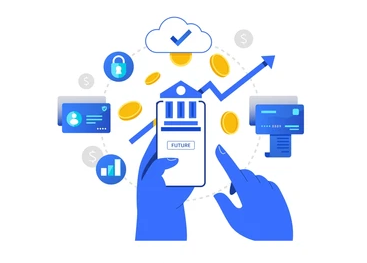
(Embedded finance and digital payment system illustration)
AI-driven platforms such as Upstart demonstrate how lending decisions can happen in seconds rather than days. Broader data models improve approval accuracy while lowering operational costs.
For marketers, this unlocks new funnel strategies. Financial offers can be embedded at moments of high intent instead of redirecting users elsewhere. The result is faster conversion and higher completion rates.
This evolution directly ties into The Real Cost of Not Owning Your Customer Data, as direct fintech models rely on first-party insights rather than third-party gatekeepers.
Supply Chains Are Becoming Intelligent Systems
Efficiency alone is no longer enough. Resilience has become a core requirement.
Disruptions caused by climate, logistics, and geopolitical shifts have exposed the limits of static supplier models. In response, organizations are adopting AI-orchestrated networks that sense change and adapt continuously.
Digital twins and predictive analytics allow leaders to simulate disruptions before they occur. Manufacturing schedules, routing decisions, and inventory planning can be adjusted proactively.

(Global supply chain network with AI-driven logistics connections)
Research suggests that companies using these systems achieve cost reductions while improving uptime. More importantly, leaders gain visibility into risk patterns long before they escalate.
The same principle applies to digital infrastructure. Clean, adaptable systems outperform rigid ones, a theme explored in Why Clean Websites Convert Better Than “Creative” Ones. Platforms like Koadz reflect this mindset by prioritizing clarity, speed, and adaptability over unnecessary design noise.
Old Models vs New Models
Across business functions, the shift from old models to new ones follows a consistent pattern. In customer interaction, traditional text-based chatbots are being replaced by voice agents that deliver higher retention through more natural, responsive conversations. In fintech, bank-led intermediary systems are giving way to direct APIs and embedded finance models, reducing transaction fees and significantly speeding up conversions. Supply chains are also evolving, moving away from static supplier networks toward AI-driven digital twins that lower operational costs while improving resilience and uptime. In each case, the newer model removes friction, shortens feedback loops, and creates measurable business gains that legacy systems struggle to match.

(Illustration of business growth and rising profits)
How Leaders Can Act Now
Reassess customer interaction layers
Audit chatbot performance and pilot voice AI in high-intent touchpoints such as onboarding or support.
Embed finance where intent peaks
Introduce direct payment or lending options inside the funnel to reduce drop-offs and speed up decisions.
Design for adaptability, not perfection
Use predictive models and dashboards to simulate disruption regularly, especially for region-specific risks.
The Bigger Pattern Emerging
These changes are not isolated upgrades. They follow a shared logic.
Voice replaces typing. APIs replace institutions. Adaptive systems replace static plans. Each shift removes friction and brings businesses closer to how people naturally interact and decide.

(Illustration showing time and financial efficiency in modern business)
Visibility within intelligent systems is becoming as important as visibility on search engines, a theme expanded in How Businesses Can Show Up in AI Answers in 2026.
The businesses that win will not be the loudest or most complex. They will be the most direct, responsive, and human.
The future of business technology is quieter, faster, and built around clarity.