
The Shift Most Teams Miss
For a long time, growth felt like a content problem. Post more. Go viral. Ride the algorithm. Hope one hit unlocks everything. That approach worked when social platforms reliably delivered reach and attention stayed cheap.
That reality has changed. Discovery has quietly shifted away from feeds and toward intent. Buyers are no longer scrolling endlessly waiting to be impressed. They are searching with purpose. They ask Google specific questions. They rely on AI tools to summarize options. They check comparison platforms before they ever click a homepage. This broader shift in discovery is already reshaping how businesses surface online, as discussed in How Businesses Can Show Up in AI Answers in 2026.
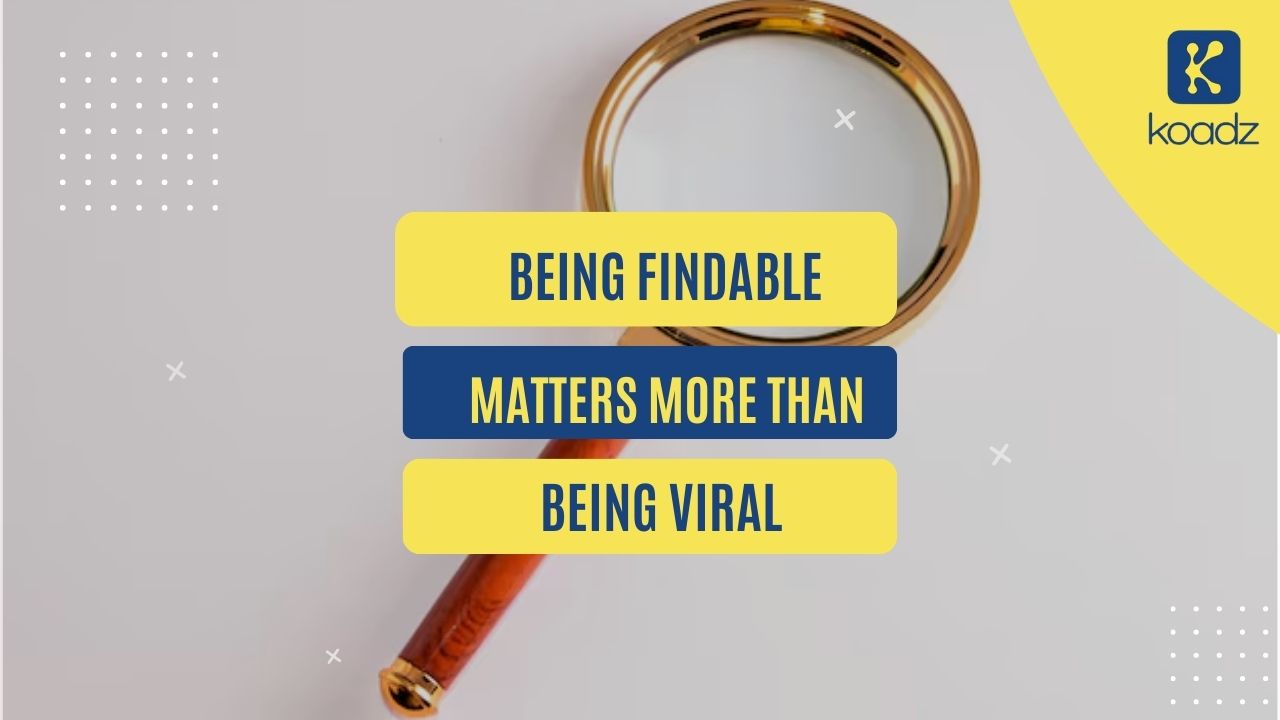
Virality still looks exciting, but it is unstable by nature. It creates spikes without continuity. Findability, on the other hand, shows up quietly at the exact moment someone is ready to decide. For SaaS growth, that difference matters more than most teams realize.
The Problem With Virality
Viral moments feel productive. Views spike. Engagement floods in. Metrics look alive. For a brief window, it feels like momentum.
Then it disappears. Most viral attention lasts hours or days before collapsing into silence. The audience is usually broad and unqualified, with little interest in buying software or solving a real problem. Attention arrives without intent.
Virality optimizes for exposure, not outcomes. It also creates platform dependency. Algorithms change. Formats rotate. Audiences move. A strategy built on virality has no control and no compounding effect. This is why attention alone stops scaling past a point, a pattern explored further in Why Attention Is the New Currency for Small Businesses in 2026.
For SaaS teams that need predictable pipeline and steady revenue, this creates a mismatch. Attention alone does not build demand. It only delays the question of where real growth comes from.
What “Findable” Actually Means in SaaS
Being findable means appearing when someone is actively looking for a solution. Not when they are killing time, but when they are researching, evaluating, or comparing tools.
This happens in search results for specific problems. It happens inside AI-generated answers that summarize options. It happens on review platforms, comparison sites, and knowledge panels that buyers trust during decision-making.
Findable content is designed to solve a question. It helps someone move forward. Viral content is consumed passively and forgotten quickly. Findable content is saved, revisited, and trusted because it removes uncertainty. Teams that build for this kind of clarity often benefit from tools like KOADZ, where structure forces intent and positioning to be explicit instead of implied.
The difference is intent. One captures attention. The other captures demand.
How Buyer Behavior Has Changed
SaaS buyers no longer browse to discover products. They query. They ask direct questions and expect clear answers. They want to know quickly whether something applies to their situation.
AI tools increasingly act as filters instead of traffic drivers. Instead of sending users to ten links, they surface a small set of answers. Those answers come from content that is clear, structured, and credible.
If a product or point of view cannot be easily understood by machines, it never reaches humans. This is the quiet risk many teams miss. You can be visible on social and still invisible at the moment someone is ready to buy.
The Business Case for Findability
Findable content behaves differently from viral content. It attracts people who already have a problem and are actively looking to solve it. That traffic converts better and aligns more closely with sales conversations.
Instead of spiking and crashing, findable content compounds. A strong page can generate qualified leads for years with minimal upkeep. Over time, it becomes part of how the market understands a category.
It also shortens sales cycles. When prospects arrive informed, conversations start at a higher level. Trust builds faster. Objections shrink.
From a cost perspective, this matters. Effort invested in findability keeps paying returns. Effort invested in virality usually pays once, if it pays at all.
Strategic Implications for SaaS Teams
The shift required is not tactical. It is mental. Teams need to stop asking, “What will perform?” and start asking, “What will be discovered and trusted?”
This changes priorities. Positioning needs to be clear in a single sentence. Pages should be structured around real buyer questions. Content should be organized so both humans and machines can understand it quickly.
Comparison pages, use case pages, and problem-specific guides matter more than broad, generic thought leadership. Architecture matters as much as copy. This is also why websites are increasingly becoming the primary credibility surface for SaaS brands, a trend covered in Why Websites Are the New Resumes in 2026.
Social content can still play a role, but it should support discovery rather than replace it. The goal is not to chase attention. It is to be present when intent appears.
Conclusion
Virality is optional. It can create moments. It can generate noise. It can even help at the margins.
Findability is foundational. In a world where buyers search, compare, and rely on AI to narrow choices, growth comes from being visible at the moment of decision. As more discovery flows through machines before humans, platforms like KOADZ quietly help teams stay discoverable by baking structure and clarity into pages from the start.
Sustainable SaaS growth does not come from being loud. It comes from being easy to find when it matters.