
A business owner sits at a decision point. The old website is outdated. Traffic is stagnant. Conversions are nonexistent. Two paths appear: hire a traditional web developer for control and customization, or use an AI website builder for speed and simplicity.
The comparison charts start stacking up. Cost, timeline, flexibility, learning curve. Both options promise results. Both have testimonials. Both seem reasonable. But the decision itself might be addressing the wrong question entirely.
Reality Check
Choosing the right builder feels strategic. It feels like the critical decision that determines whether the website succeeds or fails. But the assumption underneath is flawed.
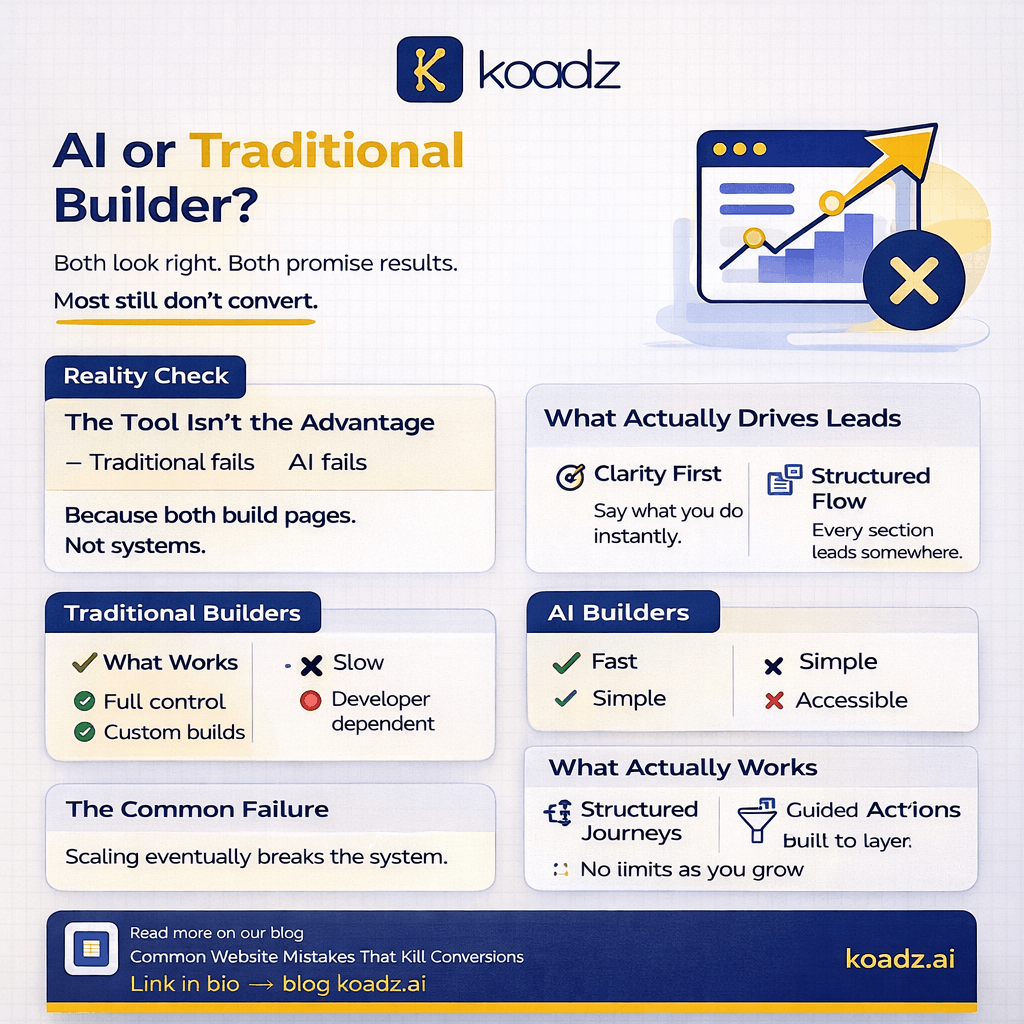
The tool does not guarantee the outcome. A traditional builder can deliver a beautifully coded site that generates zero leads. An AI builder can launch a functional site in minutes that looks fine but converts nothing. The decision between them matters less than most businesses think.
What actually determines success is not which builder was used, but whether the website was structured as a system or assembled as a collection of pages. Most builders, regardless of type, default to the latter.
What’s Actually Happening
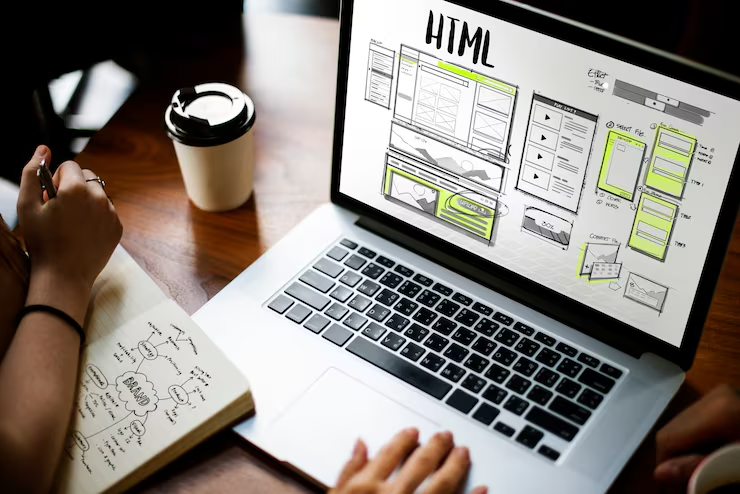
Traditional builders offer control. A developer can build exactly what the business wants, customize every detail, integrate complex functionality. The timeline is slower. Costs are higher. But the output is precisely tailored.
The advantage is flexibility. The limitation is that flexibility does not automatically produce clarity. A custom-built site can still have vague messaging, confusing navigation, and no structured user journey. The code might be perfect while the strategy is absent.
AI builders offer speed. A business can launch in hours instead of weeks. The interface is intuitive. Changes happen instantly. Costs are minimal or nonexistent during early stages.
The advantage is accessibility. The limitation is that ease of use does not guarantee effectiveness. Templates might look polished, but they are built for generic use cases. As explored in Best AI Website Builders in 2025, most tools optimize for speed, not conversion logic.
Both approaches can work. Both have legitimate use cases. But neither solves the underlying problem if the business does not understand what a high-performing website actually requires.
Where It Breaks
The shared failure point across both traditional and AI builders is the same: they focus on pages, not systems.
A traditional developer builds what the client requests. If the client asks for a homepage, an about page, a services page, and a contact form, that is what gets delivered. The pages exist. They function. But there is no structured journey connecting them. Visitors land, explore randomly, and leave without clear next steps.
An AI builder generates pages based on inputs. It asks questions, applies templates, populates content. The result is a functional website that checks all the obvious boxes. But the template is not built around conversion logic. It is built around visual completeness.
Both approaches assume that having all the standard pages equals having a working website. They do not account for user intent mapping, trust signal placement, or lead capture strategy. They deliver outputs that look like websites but do not perform like systems.
This becomes especially clear when lead volume increases. Some platforms impose intake limits. Early-stage businesses do not notice because traffic is low. But as visibility grows, the constraint reveals itself. New leads hit a cap. Submissions get blocked. Growth stalls not because of traffic, but because the system was never built to scale.
The problem is not technical capability. It is architectural philosophy. Pages can be beautiful and functional while still being ineffective. This gap is also discussed in Notion vs Website: When Each Makes Sense and Why Clean Websites Convert Better Than “Creative” Ones, where structure consistently outperforms surface-level design.

What Smart Businesses Do Differently
The businesses that succeed online do not obsess over which builder to use. They focus on whether the website operates as a system.
A system-driven website prioritizes structured flows. It maps user intent at every stage. It anticipates where visitors enter, what questions they have, and what keeps them from acting. Then it builds pathways that guide them from awareness to decision without unnecessary friction.
It treats lead capture as a multi-stage process. Not everyone is ready to book a call or fill out a detailed form. Some need lighter touchpoints. A resource, a quick answer, a pricing estimate. The system provides options that match readiness levels rather than forcing everyone through the same gate.
It is built for scalability. There are no hidden intake limits. No manual processes that break under volume. No architectural constraints that require rebuilds when the business grows. The infrastructure supports expansion from day one.
Koadz functions as an AI-powered system builder, not just a website generator. It does not simply create pages. It structures websites around conversion logic, handles lead capture without caps, and scales alongside business growth. Free setups allow for early validation, but businesses serious about consistent results need systems that remove constraints rather than introduce them. This approach aligns closely with the thinking in How to Build Your First Website with Koadz AI, where structure is prioritized from day one.
The Real Shift
Most businesses spend energy choosing between builders when they should be evaluating whether the builder produces systems.
A website is not a digital brochure. It is not a collection of information. It is a structured path from curiosity to action. The tool that builds it matters far less than whether the result functions as a cohesive system.
Traditional builders can create systems if the client understands what to request. AI builders can generate systems if the underlying logic is built in. But without that foundation, both produce the same result: functional pages that do not convert.
The real question is not which builder to choose. It is whether the output will guide visitors deliberately, capture leads strategically, and scale without breaking. Everything else is secondary.