

The Collapse of Traditional Search Dominance
Search engine optimization once relied on keyword density, backlink profiles, and meta descriptions under the assumption that users would type queries into a search bar and click through ranked results. That assumption has collapsed. Generative AI platforms now synthesize answers directly from indexed content without presenting traditional blue links. ChatGPT, Perplexity, Google’s AI Overviews, and Bing’s Copilot extract information, rewrite it, and serve it as conversational responses. Traffic dies at synthesis.
A website ranked third for “enterprise SaaS pricing models” might receive zero visits if a generative engine summarizes pricing structures from multiple sources and presents them as a single, authoritative answer. The user achieves satisfaction. The website receives nothing, no click, no impression, no conversion opportunity.
This shift also reflects what’s explored in Is Blogging Dead in 2026 Or Has Its Role Quietly Changed?, where content hasn’t lost relevance but has moved upstream into how answers are constructed rather than how clicks are earned.

(A stylized search bar surrounded by icons like messages, images, notifications, and ratings, representing how different types of content are processed and surfaced in modern search experiences)
What Generative Engine Optimization Actually Measures
Generative Engine Optimization structures content so that AI models select, cite, and attribute it during answer generation. Unlike SEO, which optimizes for ranking algorithms, GEO optimizes for extraction and synthesis algorithms. Position one on a search results page no longer matters. Becoming the source material that a generative engine quotes, paraphrases, or links to when constructing an answer matters.
Content architecture still needs to change, but not in a vague way. Generative engines tend to prioritize modular, semantically dense, explicitly structured content. Pages with clear headings, concise definitions, and data presented in tables or lists usually get picked more often. Verbose introductions, repeated phrasing, and content that takes multiple paragraphs to make a single point tend to get ignored or skipped.
A 2,000 word blog post with one useful statistic buried in paragraph seven will lose to a 300 word page where that same statistic appears in the first sentence, clearly labeled and supported.
This is closely tied to How Businesses Can Show Up in AI Answers in 2026, where visibility is less about ranking position and more about whether your content gets selected during synthesis.
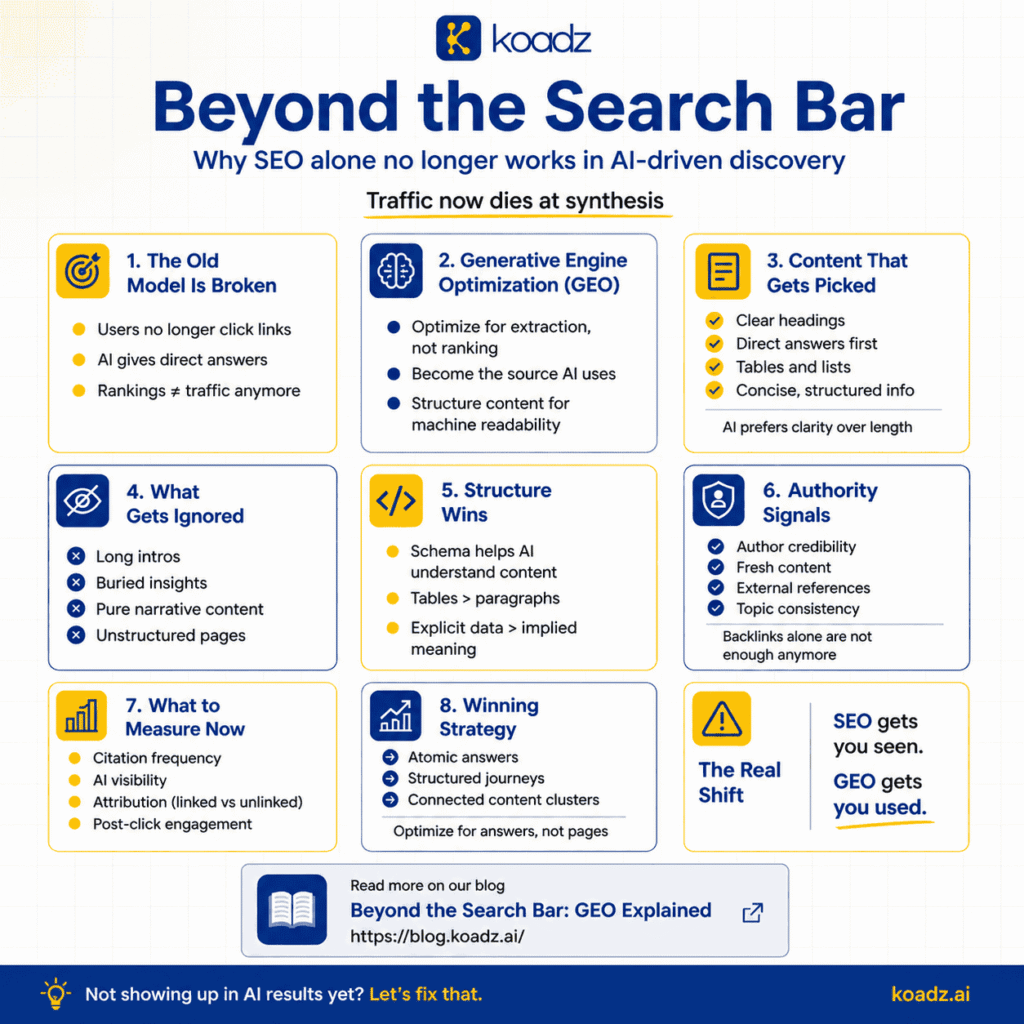
(An infographic showing how AI-driven search selects and presents content based on structure, clarity, and authority)
Structural Markup and Schema Implementation
Generative engines parse structured data more reliably than unstructured prose. Schema.org markup, especially JSON LD, provides explicit semantic labels that AI models use to identify entities, relationships, and hierarchies. A product page marked up with Product schema, including price, availability, and reviews, feeds directly into AI generated comparisons. An FAQ page using FAQPage schema becomes a preferred source for question answering tasks.
Generative engines do not guess. A page describing a product but failing to declare it as a Product entity can be misclassified as editorial content. A page containing a list of statistics but not structuring them properly can get skipped in favor of a competitor that presents the same data more clearly.
Tables, bullet points, and numbered lists consistently outperform paragraph based content in these cases. A generative engine asked to compare cloud storage providers will extract data from a table with columns for price, storage limits, and encryption standards. Narrative comparisons that contain the same information but bury it in sentences often get ignored.
The impact of this becomes clearer in The Role of Schema Markup in AI Driven Discovery, where structured content consistently outperforms unstructured pages in being surfaced and reused.
Citation Probability and Authoritativeness Signals
Generative engines select sources based on perceived authority, which comes from a mix of citation frequency, author credentials, publication recency, and corroboration by other sources. Domain age does not matter much here. PageRank also matters less than it used to.
A page cited by multiple authoritative sources on the same topic has a higher chance of being used, even if another page has similar content. Author bylines also carry weight. A technical article written by a named engineer with a visible track record will usually outperform an unsigned blog post.
Generative engines cross reference author identities and verify credentials. A page claiming expertise without any visible proof tends to drop in priority. Recency also shifts things quickly. A newer page with updated information can replace an older one even if the older page had stronger backlinks.

(A digital interface displaying AI analyzing data streams, representing how AI systems process and interpret information for search and discovery)
Optimizing for Answer Engines vs Discovery Engines
Answer engines and discovery engines serve different purposes, and the content needs to reflect that. Answer engines like ChatGPT and Perplexity respond to direct queries, so they favor content that delivers a complete answer within a single section. Each section should stand on its own so the model can extract it without needing to process the entire page, which reduces processing time and increases the likelihood of being used.
Discovery engines like Google’s AI Overviews and Bing Copilot work differently. They surface broader content and rely more on coverage across related topics. A page needs to demonstrate depth, not just by answering one question, but by covering multiple related aspects clearly and in separate sections. This signals completeness and increases the chances of appearing across different query variations.
Internal linking also plays a role here. Pages that connect to related topics help generative systems understand how content fits into a larger topical cluster. Well-connected clusters tend to signal stronger expertise and improve overall visibility.
This distinction also connects to Why Being Findable Matters More Than Being Viral for SaaS Growth, where consistent presence across queries matters more than isolated bursts of visibility.
Measurement Frameworks for GEO Performance
Traditional SEO metrics like impressions, clicks, and rankings do not capture GEO performance accurately. A page can lose a significant portion of its search traffic while still appearing more frequently inside AI generated answers, which makes traditional reporting misleading.
New metrics focus on citation frequency, how often a page is used or referenced in generated responses, and attribution, whether the source is explicitly linked or simply paraphrased. A page that appears in a higher percentage of relevant AI responses demonstrates stronger GEO performance regardless of its ranking position.
Attribution matters because only linked citations drive traffic. Paraphrased mentions increase visibility but do not generate visits. Engagement after the click also becomes important. Users who land on a page and leave immediately indicate that the content answered the query but failed to provide further value, while users who explore additional pages signal deeper engagement and stronger content quality. Traffic originating from generative engines behaves differently and needs to be analyzed separately from traditional search traffic.
This is similar to the shift discussed in How to Measure Experience, Not Just Performance, where traditional metrics stop reflecting actual user interaction and deeper signals become more meaningful.

(A person interacting with a futuristic data dashboard, representing continuous content updates and real-time information analysis)
Content Velocity and Continuous Updating
Static content degrades quickly in GEO environments because generative systems continuously update their data sources. A page that performs well today can lose visibility when newer, more relevant content is published by competitors.
Updates need to be substantive. Changing a publication date without adding new information has little impact and is often ignored. Meaningful updates include adding new data, revising analysis, or expanding coverage in a way that provides clear additional value. Regular updates signal that a page is actively maintained, which improves its likelihood of being selected.
Changelogs strengthen this signal by documenting what changed, when it changed, and why. They provide transparency and also serve as a reference point for future comparisons, which can increase credibility over time.
Content pruning is equally important. Removing outdated or underperforming pages reduces confusion and concentrates authority on current, relevant content. A smaller set of accurate, well maintained pages performs better than a larger collection of outdated or redundant ones.