

Customer support rarely fails because teams stop caring. It fails because growth changes the structure of demand faster than most organizations redesign their systems.
In early-stage companies, support feels manageable. Volumes are low, customers are forgiving, and agents can rely on product knowledge rather than rigid processes. A small team can resolve most issues manually using shared inboxes, informal documentation, and direct communication.

(Customer support agent handling messages across digital channels)
As businesses grow, this approach stops working. Support demand does not increase proportionally. It expands with complexity. Every new customer segment, feature, market, and channel introduces new questions and new points of failure. Over time, support shifts from conversation-driven work to infrastructure-level operations.
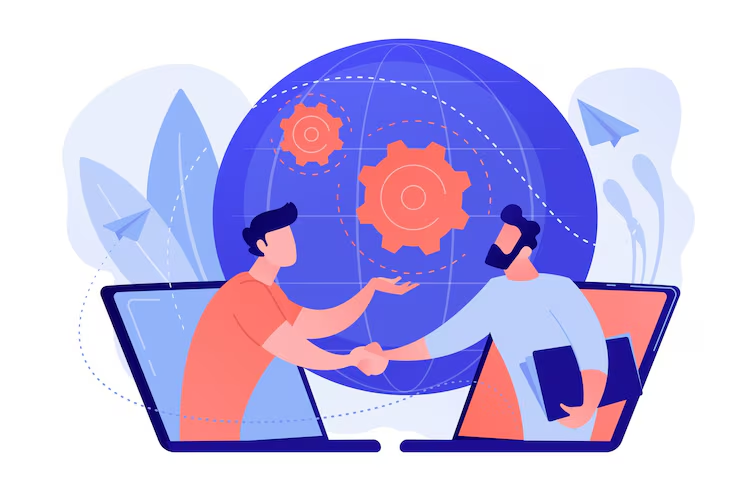
(Illustration of digital customer support collaboration)
This is also the point where organic growth alone becomes unreliable. As explained in Why Word of Mouth Stops Working After a Certain Size, operational weaknesses surface faster at scale, and customer experience becomes a growth constraint rather than a growth driver.
How Growth Changes the Nature of Support
Growth alters customer support in predictable ways.
First, demand becomes volatile. Seasonal campaigns, holidays, and product launches often create sharp spikes that are difficult to forecast accurately. When staffing lags behind demand, wait times increase and resolution quality declines.
Second, issue diversity increases. As products mature, edge cases multiply. Support teams spend more time diagnosing uncommon scenarios rather than answering standard questions.

(Illustration representing complex customer support challenges)
Third, consistency becomes harder to maintain. Expanding into new regions introduces language differences, cultural expectations, and regulatory constraints. These challenges mirror the broader operational patterns discussed in How Geography Still Shapes Digital Business More Than We Admit.
When systems do not adapt to these changes, support becomes the visible point of failure.
The Hidden Cost of Manual Support at Scale
Manual support creates internal inefficiencies that are often underestimated.
Agents regularly lose time switching between tools, searching for customer history, and reconciling inconsistent data. When customer data is fragmented across platforms, resolution times increase and personalization suffers.

(Illustration of manual customer support and data management)
This problem is closely tied to data ownership. As outlined in The Real Cost of Not Owning Your Customer Data, businesses that lack centralized, accessible customer data struggle to automate workflows or scale service quality reliably.
Manual processes also pull leadership attention away from long-term planning. Escalations during peak periods divert product and engineering teams toward reactive fixes instead of preventive improvements.
Why Support Load Grows Faster Than Headcount
Hiring more agents is a common response to rising support volume, but it rarely addresses the underlying issue.
Support load grows faster than headcount because multiple factors compound simultaneously.
More users create more questions.
More features introduce more failure points.
More markets increase contextual complexity.
More agents introduce variability in responses.
Without structural changes, increasing team size only delays breakdown rather than preventing it.
What Replaces Manual Support in Scalable Organizations
Organizations that scale support successfully focus on reducing avoidable contact instead of reacting to every request.
Automation of Repetitive Tasks
Automation is widely used to handle predictable activities such as ticket routing, order updates, refunds, and basic account changes. When automation is connected to accurate customer data, it improves response speed without compromising reliability.
Clear digital interfaces also play a role here. Businesses with well-structured websites and support portals reduce confusion before customers reach out. Some teams use AI website builders like Koadz to maintain consistent layouts and structured content, which helps users find answers without escalating to support.

(Customer support agent wearing a headset)
As AI-driven interfaces increasingly surface answers directly, support documentation and help content also influence visibility. This overlap is explored further in How Businesses Can Show Up in AI Answers in 2026.
Forecasting and Flexible Staffing Models
Data-driven forecasting allows teams to anticipate demand patterns weeks in advance by aligning support planning with marketing and sales activity.
Flexible staffing models, including external support partners, are often used to handle predictable peaks. This approach enables faster scaling without long-term overhead and helps maintain coverage across time zones.
Self-Service as a Primary Support Channel
Self-service has become central to scalable support strategies.
Well-organized help centers, searchable knowledge bases, and guided workflows allow customers to resolve common issues independently. When information is clear and easy to navigate, customers consistently prefer self-resolution.

(llustration of self-service customer support)
Website structure matters here. Clean information architecture and predictable navigation reduce unnecessary support requests. Tools such as Koadz are sometimes used to keep support-related pages consistent as content grows, which helps maintain clarity without constant manual redesign.
Preventive Customer Experience Design
Preventing issues is more efficient than resolving them after frustration builds.
Clear onboarding, intuitive product flows, proactive notifications, and real-time feedback monitoring all reduce avoidable support volume. During high-demand periods, centralized dashboards help teams detect issues early and respond before dissatisfaction spreads.
Conclusion
Customer support does not scale by adding more people. It scales through design.

(Illustration of designing scalable systems)
As businesses grow, support must evolve from manual conversations into a resilient operational system. This requires unified customer data, accurate forecasting, effective self-service, and preventive experience design.
The companies that scale best are not those with the largest support teams. They are the ones that remove friction, reduce complexity, and build systems that make support necessary less often.