

Why Your Online Presence Is Your First Impression and What It Actually Includes
Before a potential customer calls you, emails you, or walks into your store, they have almost certainly already Googled you. Research by BrightLocal found that 98% of consumers used the internet to find information about local businesses in 2023, and a significant portion of them make a judgment call about credibility within the first few seconds of landing on a website or social profile.
Your online presence is not just your website; it is the complete digital footprint your business leaves across the internet, your website, your Google Business Profile, your social media accounts, your presence in online directories, and the reviews customers leave about you across platforms. The reassuring truth for small business owners is that building a professional, credible online presence across all of these touchpoints no longer requires a developer, a designer, or a large budget.

The tools available today are powerful enough that with the right strategy and a few hours of focused effort, any business owner can build something that looks and functions at a genuinely professional level.
Choosing the Right Website Platform and Getting the Basics Right
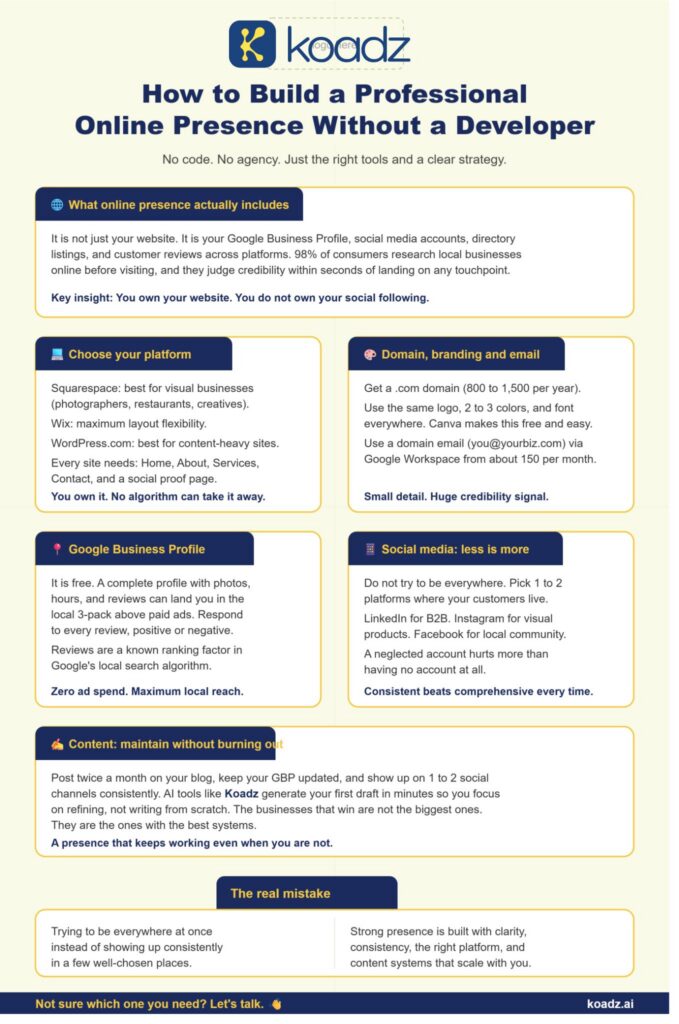
Your website is the only digital asset you fully own and control. Your social media following can disappear overnight if a platform changes its algorithm or shuts down, but your website is yours. The three most accessible no-code website platforms for small businesses are Squarespace, Wix, and WordPress.com, each with distinct strengths. Squarespace is best for businesses where visual aesthetics are central, photographers, restaurants, boutiques, and creative services, because its templates are among the most design-polished available and the editor keeps you within a system that is hard to make look bad.
Wix offers the most layout flexibility through its drag-and-drop editor, making it ideal for businesses with unique structural needs, though that freedom also makes it easier to create something inconsistent if you do not have a clear design direction. WordPress.com scales best for businesses that plan to invest heavily in blogging and content marketing over time, given its unmatched ecosystem of SEO plugins and content tools.
Regardless of platform, every professional website needs five core pages without exception: a Home page that communicates what you do and who you serve within five seconds of landing, an About page that builds trust through your story and credentials, a Services or Products page with clear descriptions and transparent pricing where possible, a Contact page with multiple methods of reaching you, and a page dedicated to social proof in the form of testimonials, client logos, or case studies.
Domain, Branding, and Professional Email: The Details That Signal Legitimacy
The small details of your online presence communicate more about your professionalism than most business owners realize. Your domain name, your website address, should ideally match your business name exactly, be kept as short and easy to spell as possible, and end in .com where available, as it remains the most universally trusted domain extension globally.
Domains typically cost between Rs. 800 and Rs. 1,500 per year through registrars like GoDaddy or Namecheap and are one of the most cost-effective credibility investments you can make. Design consistency across your entire online presence, using the same logo, the same two or three brand colors, and the same font pairing everywhere from your website to your social media profiles to your email signature, is what creates the perception of a polished, established brand rather than a hastily assembled one. Canva is a free tool that makes maintaining this consistency entirely accessible without design experience, offering logo makers, brand kit storage, and templates for every social platform and marketing format imaginable.

Professional email deserves particular emphasis: using a domain-based email address (yourname@yourbusiness.com) instead of a personal Gmail or Yahoo account costs as little as Rs. 150 per month through Google Workspace and is one of the highest-signal credibility markers in any B2B or B2C interaction. It immediately communicates that you are running a real business, not a side project.
Google Business Profile and Directory Listings: Free Visibility You Cannot Afford to Skip
One of the most underutilized free tools in small business marketing is Google Business Profile, formerly known as Google My Business. A fully optimized Google Business Profile with accurate contact information, correct business category, operating hours, high-quality photos of your space or products, and a consistent flow of customer reviews can drive significant local discovery entirely without ad spend.
Businesses with complete profiles are eligible to appear in the local “3-pack,” the three business listings that appear at the very top of Google search results for location-based queries, above all regular organic results and often above paid ads. Beyond Google, being listed in relevant online directories, Justdial, Sulekha, and IndiaMart for Indian businesses, or industry-specific platforms relevant to your sector, builds both visibility and the kind of citation consistency that strengthens your local SEO.
Actively collecting and responding to customer reviews across these platforms matters enormously: not only do reviews influence purchasing decisions directly, but the volume and recency of reviews are known ranking factors in Google’s local search algorithm. Responding to reviews, both positive and negative, signals to potential customers and to Google that your business is active, engaged, and trustworthy.
Content and AI Tools: Maintaining Your Presence Without Burning Out
The biggest challenge small business owners face with their online presence is not setting it up; it is maintaining it consistently over time. Social media profiles that have not been posted to in months, blogs with three posts from two years ago, and Google Business Profiles with outdated hours all actively damage credibility rather than building it.

The solution is not to try to do everything, but to choose two or three channels where your customers actually spend time and commit to showing up there consistently with genuinely useful content. For most small businesses, this means a maintained website with a blog updated at least twice a month, an active presence on one or two social platforms, and a regularly updated Google Business Profile. Content creation is where many business owners stall.
Knowing you should post is very different from knowing what to post and having the time to write it. This is where AI-powered tools like Koadz can be genuinely transformative: rather than staring at a blank page, you can use Koadz to generate first drafts of blog posts, social captions, email newsletters, and product descriptions in a fraction of the time, freeing you to focus on refining and personalizing the content rather than producing it from scratch. The businesses that maintain a consistent, high-quality online presence over the long term are not the ones with the largest teams. They are the ones that have built efficient systems for content creation and use the right tools to sustain them.