
People do not trust brands.
They trust the humans behind brands.
A founder without a visible presence is like a chef who never tastes their own food. Everything might look good on the plate, but no one trusts the flavor.

(A person holding a sign that reads “You are your own brand,” symbolizing the importance of founder visibility and personal branding.)
In a digital world saturated with polished ads, automated emails, and AI-generated copy, audiences are no longer persuaded by logos or taglines. They are persuaded by people. Specifically, by people who show up consistently, speak honestly, and demonstrate lived experience.
This is increasingly true as attention, not reach, becomes the limiting factor for growth, a shift explored in Why Attention Is the New Currency for Small Businesses in 2026.
Your story is not just context. It is leverage.
Why Audiences Feel More Connected to Creators Than Companies
Today’s audiences spend more time with creators than with corporations. They follow individuals on LinkedIn, X, YouTube, and Substack, not because those individuals are famous, but because they are familiar.
This is one reason tools like Koadz focus on helping founders translate their voice into owned digital spaces, rather than producing generic brand pages.
Creators talk in first person.
They share process, not just outcomes.
They explain why decisions were made, not just what was launched.
This creates perceived proximity.
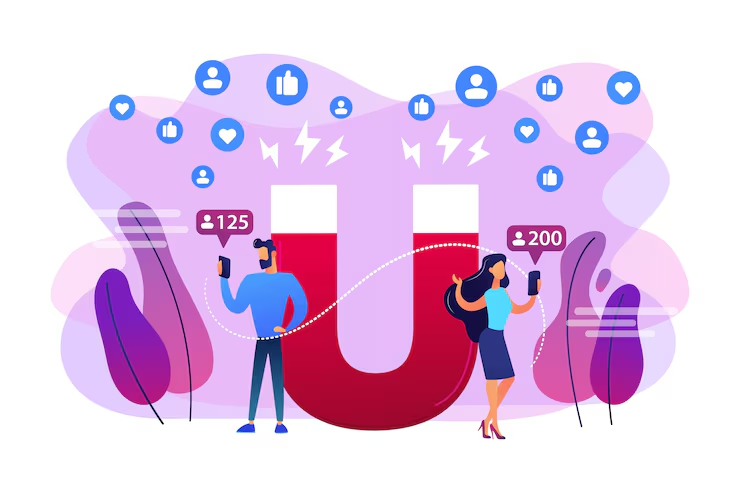
(Illustration showing creators attracting audience engagement through likes, follows, and interactions, representing stronger human connection than corporate brands.)
According to Edelman’s 2024 Trust Barometer, 81 percent of consumers say they trust people like themselves more than institutions or brands. This trust gap is widening as content becomes easier to mass-produce. AI has made “good enough” content abundant. Human context is now the differentiator.
Founders who understand this do not outsource their voice entirely. They participate in the conversation.
What Founder Presence Actually Does
ounder presence is not about posting selfies or motivational quotes. At its core, it performs four critical business functions.
1. It Adds Narrative
Brands without founders in the foreground often sound static. Features, benefits, and announcements lack a storyline.
When a founder shows up, the brand gains continuity. Decisions have context. Pivots have explanations. Wins and losses feel earned.
This same narrative consistency is what strong brand systems protect, as outlined in The 2026 Guide to Brand Image Consistency Across Your Website.
A narrative answers questions customers subconsciously ask:
- Why does this company exist?
- What does it believe?
- Who is accountable when things go wrong?
These answers are difficult to communicate through brand copy alone.

(Illustration of a business leader standing confidently beside a shield, representing trust, credibility, and protection built through visible founder leadership.)
2. It Builds Trust Faster
Trust usually takes time. Founder visibility compresses that timeline.
When people repeatedly hear from the same individual, see their thinking evolve, and observe how they respond to feedback, credibility compounds. This is one reason founder-led content consistently outperforms company page content on platforms like LinkedIn.
Data from HubSpot indicates that deals close up to three times faster when prospects already trust the leadership behind a product. Trust reduces friction. It shortens sales cycles and lowers acquisition costs.
This trust-first dynamic is central to modern personal branding, explored further in How to Build a Personal Brand in 2026: A Practical Guide for Everyone.
3. It Differentiates in Crowded Markets
In saturated categories, most products look interchangeable. Messaging converges. Pricing becomes the primary lever.
Founder perspective breaks that symmetry.
This mirrors why traditional word-of-mouth loses power at scale, a challenge discussed in Why Word of Mouth Stops Working After a Certain Size.
Two startups can sell similar software. Only one can share a firsthand story about why a specific problem was worth solving, what trade-offs were made, and what lessons were learned the hard way.
That context is not replicable.
4.It Makes the Brand Feel Alive
Brands that never speak through a human voice often feel transactional. Founder presence introduces emotion, conviction, and responsiveness.
This matters not only for customers, but also for employees, partners, and investors.
It also directly affects how brands surface in AI-driven discovery environments, as explained in How Businesses Can Show Up in AI Answers in 2026.
Why Faceless Brands Struggle Today
Faceless brands are not failing because they lack effort. They are failing because the environment has changed.
AI Has Flattened Content Quality
AI tools have raised the baseline. Most brand content now sounds competent. Clear. Polished.
It also sounds similar.
This is why blogging has not disappeared but evolved into a trust layer, a shift examined in Is Blogging Dead in 2026? Or Has Its Role Quietly Changed?

(Illustration showing a faceless brand separated by a wall from people, representing generic messaging and lack of human connection.)
Generic tone, interchangeable frameworks, and predictable positioning statements make it difficult for audiences to form attachment. Without a human signal, brands blur together.
Algorithms Favor Humans
Social platforms consistently prioritize content from individuals over companies. Founder posts generate more comments, longer dwell time, and higher organic reach.
This is not accidental. Platforms optimize for conversation, not broadcasting.
How Founder Presence Compounds Over Time
Founder visibility is not a short-term tactic. It is a compounding asset.
Long-Term Trust
Repeated exposure builds familiarity. Familiarity builds trust. Trust builds preference.
This is why founder-led brands often retain customers even when competitors offer lower prices. Loyalty is emotional before it is rational.
For many founders, their website has become the first trust checkpoint, which is why platforms like Koadz are increasingly used as extensions of founder credibility, not just page builders.

(Illustration showing people collaboratively building an upward growth line, representing long-term trust and brand growth created through consistent founder presence.)
Community Formation
When founders consistently share insights, audiences begin to gather around shared beliefs, not just products. This turns customers into advocates and passive followers into participants.
Email newsletters, personal LinkedIn followings, and Substack audiences are examples of owned trust channels. Unlike company pages, these are not rented distribution.
Failing to build these channels often leads to hidden long-term costs, outlined in The Real Cost of Not Owning Your Customer Data.
Forgiveness When Mistakes Happen
Every startup makes mistakes. Delays, bugs, missteps.
Founders who have built visible trust are given more grace. Transparency humanizes failure and reduces backlash. Silence does the opposite.
What Founder Presence Is Not
Clarity matters here.
Founder presence is not narcissism.
It is not personal oversharing.
It is not influencer behavior optimized for attention.
Effective founder presence is service-oriented. It is about sharing perspective, not seeking validation.

(Illustration of a leader guiding a group with an idea, representing authentic leadership focused on direction and service rather than attention seeking.)
Top founders often follow a value-first ratio. Approximately 90 percent insight, education, or reflection. 10 percent asks or promotion. This approach allows audiences to self-qualify long before a pitch is ever made.
Close: The Founder Is the Bridge
The founder is not the brand.
The founder is the bridge between the brand and the people it serves.

(Illustration of people shaping content on a digital screen, representing founders using content to connect brands with their audience.)
In an era of automation, sameness, and noise, human presence is the signal.
Founder visibility is not optional anymore. It is a strategic advantage that compounds over time.
Pick one platform. Share one real insight. Start today.
Trust is built in public.