
Most businesses track customer journeys from the first recorded touchpoint. Someone visits a website, submits a form, receives follow-up communications, and eventually converts. This visible sequence captures only a fraction of what actually happens. The majority of decision-making occurs before the business has any awareness of the person conducting research.
By the time someone makes initial contact, they have already formed opinions. They have researched competitors, read reviews, checked pricing, and developed criteria for evaluation. The decision is often half-formed before the first conversation takes place. Businesses optimizing only the visible portion of the journey miss the reality that influence happens primarily in the stage where they have no direct visibility or control. This shift in behavior also connects with broader changes in user journeys, as explored in The Shift Away from Traditional Marketing Funnels (And What Replaces Them in 2026).
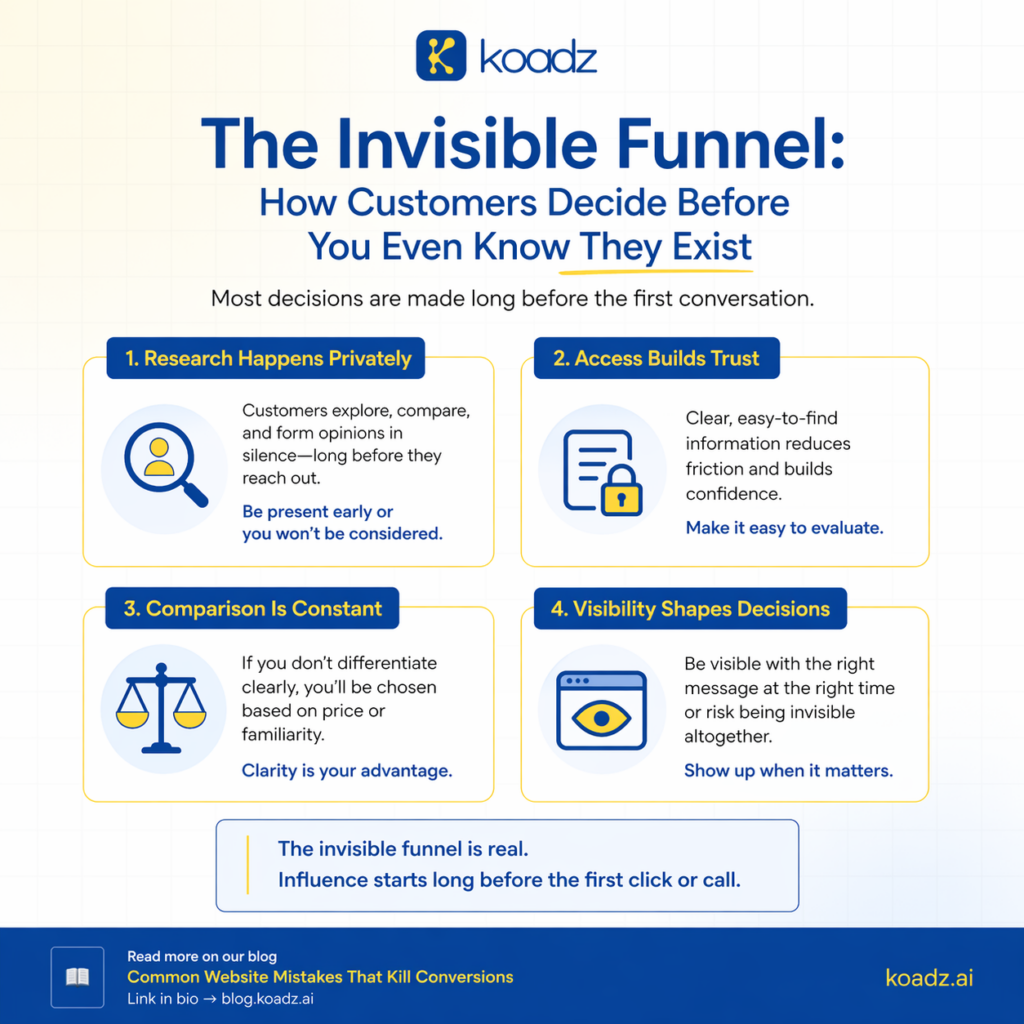
(Infographic explaining the invisible funnel, showing how customers research, compare, and decide before directly engaging with a business)
Research Happens in Channels Businesses Cannot Monitor
People do not announce when they begin evaluating solutions. They search quietly, compare options in private browser tabs, and discuss possibilities in internal conversations or direct messages. A potential buyer might spend weeks building knowledge without engaging with any company directly. They watch demo videos, scan documentation, and review competitor websites to construct a mental model of available options.
This invisible research establishes expectations long before contact occurs. Someone who has already examined five competitor sites before reaching yours is not starting fresh. They are comparing. They have developed a baseline sense of standard features, typical pricing ranges, and communication styles that feel trustworthy. Your site gets judged against an internal benchmark formed from everything they have already absorbed.
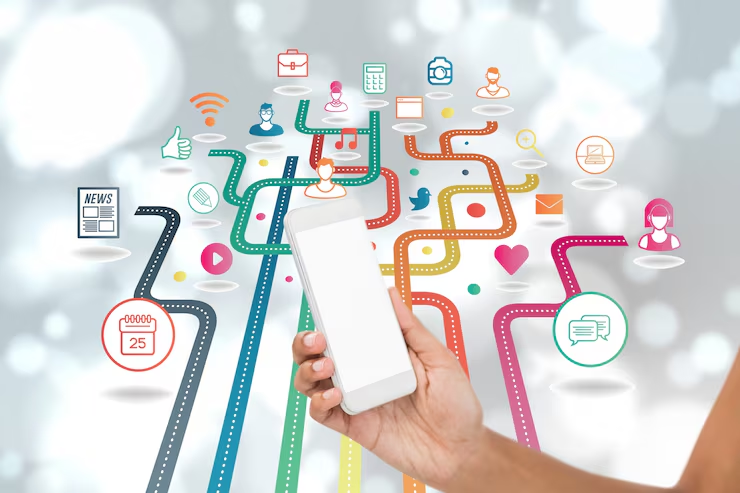
(Illustration of a smartphone connected to multiple digital pathways, representing customer research, online comparison, and decision-making journeys)
Businesses underestimate how much information customers gather independently. They assume people need guidance, so they gate content behind forms or require conversations to access details. Customers want to evaluate on their own timeline. They want to understand products, assess fit, and build confidence without external pressure. Friction does not create engagement opportunities. It drives people toward competitors who make information easier to access. Many of these gaps in accessibility originate from foundational website decisions, which are explored in Before You Build a Website: 7 Things You Must Get Right.
Trust Forms Through Accessibility, Not Persuasion
The invisible stage is where trust either develops or fails. Trust at this point does not come from persuasive language or sales techniques. It comes from transparency and ease of access. Can someone find pricing without submitting personal information? Can they see concrete examples of how the product works? Can they determine whether it fits their situation without talking to anyone?
When critical information is hidden, customers assume the worst. They assume pricing is prohibitive, the product is overly complex, or the business lacks confidence in its own value. These assumptions form before any sales interaction takes place. Once someone contacts the business, they have already decided whether it seems credible, and reversing negative first impressions proves extremely difficult.
Businesses that succeed in the invisible funnel make everything accessible. Pricing is public. Use cases are detailed. Documentation is available without barriers. This does not mean revealing proprietary information. It means removing unnecessary obstacles to understanding. A visitor should be able to assess fit independently. If they do reach out, it should be because they have determined the product is relevant, not because they are still trying to figure out what it does.
Every Evaluation Involves Comparison
The invisible funnel never involves isolated assessment. Customers always compare, even when they do not explicitly mention it. They have multiple tabs open, multiple options under consideration, and multiple criteria they are weighing against each other. Assuming evaluation happens in isolation misses the context in which decisions actually occur.
Differentiation must be immediate and obvious. If someone cannot identify what makes a business distinct from alternatives within seconds, they default to comparing based on price or brand familiarity. Differentiation does not come from claiming superiority. It comes from being specific enough that the difference is self-evident. A company saying it helps teams collaborate sounds identical to dozens of others. One saying it helps distributed engineering teams manage asynchronous code reviews has defined a specific position that makes comparison easier.
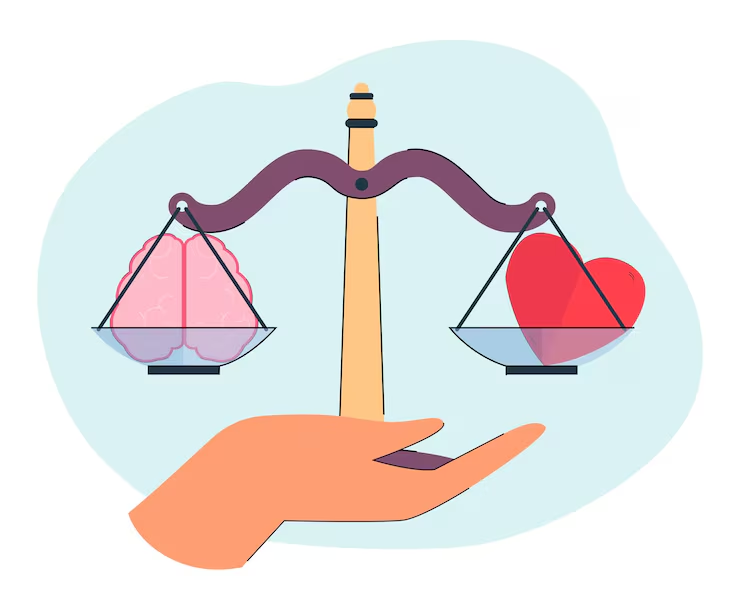
(Illustration of balanced scales weighing logic and emotion, symbolizing customer comparison and decision-making factors)
Clear positioning reduces the need for extended evaluation. When someone knows exactly what a product is designed for and who it serves, they can quickly determine fit. Vague positioning forces prolonged comparison because there is no clear decision basis. The longer someone spends comparing, the more likely they are to choose based on secondary factors like pricing or brand recognition rather than actual suitability. This lack of clarity in positioning is often rooted in messaging issues, discussed in What 90% of Business Owners Get Wrong About Branding.
Visibility During Research Accelerates Decision Influence
The invisible funnel operates whether businesses are prepared for it or not. Customers research, compare, and form opinions regardless of whether a company has optimized its presence. This creates urgency around establishing a clear online presence. Every day without one is a day potential customers are making decisions with incomplete or outdated information about what the business offers.
Traditional website development takes weeks or months. During that time, the invisible funnel keeps running. Competitors get evaluated. Impressions get formed. By the time a new site goes live, opportunities have already passed. Speed matters because it closes the gap between having something valuable to offer and being visible to people who need it.
Koadz addresses this by enabling businesses to launch functional websites in minutes. This does not mean deploying something unfinished. It means getting a clear, professional presence established quickly enough to influence the invisible funnel while customers are still researching. The site can evolve based on feedback and observed behavior, with the initial presence ensuring that people forming opinions have accurate, current information to base those opinions on.
The invisible funnel is where most decisions take shape. Businesses focusing only on optimizing what happens after contact are intervening too late. The meaningful work is ensuring that when someone researches independently, they find clarity, transparency, and enough information to build trust before ever making contact. That requires being visible, accessible, and specific long before the first conversation occurs.