
For decades, the marketing funnel provided a clean framework for understanding customer behavior. Awareness at the top, consideration in the middle, conversion at the bottom. The model suggested a predictable path where prospects moved through discrete stages, each one bringing them closer to a purchase decision. That framework no longer reflects how people actually buy.
Modern customers enter conversations at unpredictable points. Someone might discover a product through a recommendation and immediately check pricing, skipping any awareness stage entirely. Another person might research extensively for months, comparing options across multiple platforms, then go silent before suddenly converting through an entirely different channel. This shift in behavior also reflects how decisions happen before direct interaction, explored in The Invisible Funnel: How Customers Decide Before You Even Know They Exist
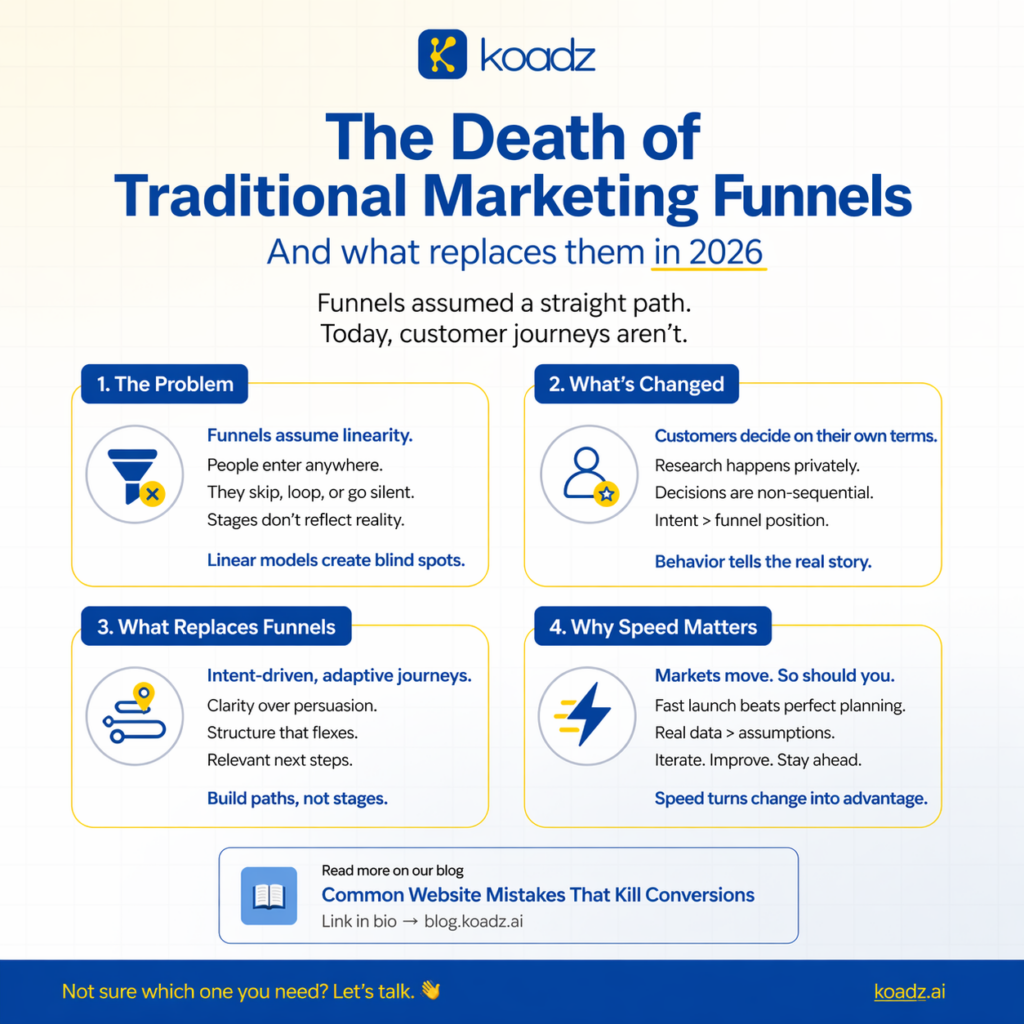
(Infographic explaining the decline of traditional marketing funnels and the shift toward adaptive, customer-driven decision journeys)
Decision-Making Has Become Non-Sequential
The traditional funnel works only if people move from one stage to the next in order. Businesses still design content around this assumption, creating awareness campaigns for new visitors, nurture sequences for prospects showing interest, and closing tactics for those nearing a decision. The problem is that visitors do not arrive with labels indicating which stage they occupy.
This disconnect creates friction. Messaging often lands out of sync with intent. Many of these breakdowns also come from weak communication foundations, something discussed in What 90% of Business Owners Get Wrong About Branding. A person ready to buy encounters messaging aimed at building awareness. Someone early in their research process gets pushed toward conversion before they have enough context.
Customers gather information in bursts, often across weeks or months. By the time someone makes contact, much of the decision is already shaped.

(Person selecting “Yes” on a digital decision interface, representing customer intent, choice, and modern decision-making processes)
Systems Built Around Intent Work Differently
Intent reveals more than funnel position ever could. Someone searching for product specifications has different needs than someone looking for high-level overviews.
Designing for intent means creating pathways that allow people to move at their own speed. Structuring content around real user behavior connects closely with principles outlined in Before You Build a Website: 7 Things You Must Get Right. A visitor ready to act should not be slowed down, while someone still evaluating should find depth without pressure.
Clarity becomes the mechanism that enables this. When someone lands on a page, they should understand what the business offers and whether it is relevant within seconds.
Structure Must Accommodate Complexity Without Creating Confusion
The funnel breaks under complexity. Different users arrive with different needs, even if they are new.
Structured journeys solve this by allowing divergence based on behavior. What someone clicks or explores reveals what they need next. When systems respond to these signals, navigation becomes intuitive rather than forced.
This does not require elaborate systems. It requires clarity in how content is organized and how next steps are presented.
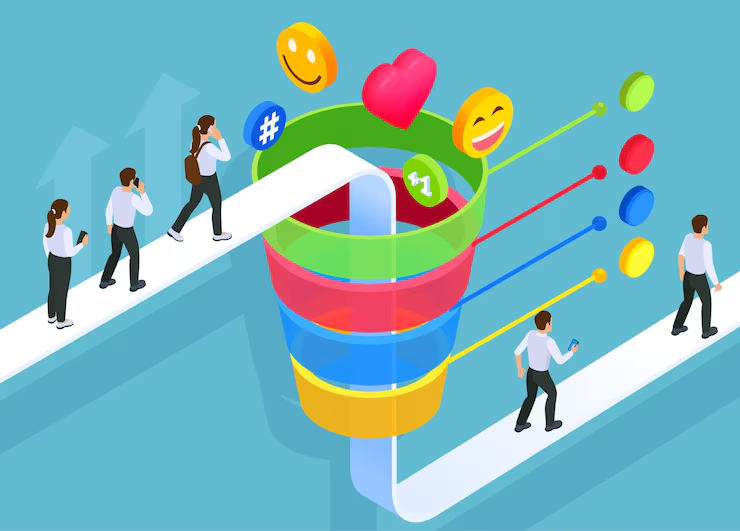
(Illustration of a colorful marketing funnel with multiple customer pathways, symbolizing evolving customer journeys and adaptive business systems)
Getting Systems Live Quickly Matters More Than Refinement
The shift away from traditional funnels creates opportunity for businesses that adapt faster than customer behavior changes. Traditional website projects often take weeks or months. By the time something goes live, assumptions may already be outdated.
Speed enables learning. Businesses can observe real behavior and refine based on evidence.
Koadz makes this possible by removing technical barriers. A functional site can go live in minutes, allowing continuous improvement based on how users actually interact.
Success will not come from refining funnel stages. It will come from building systems that align with how people actually make decisions. That requires clarity, flexibility, and the ability to adapt quickly as behavior continues to evolve.